Sharif Bey
Syracuse, NY
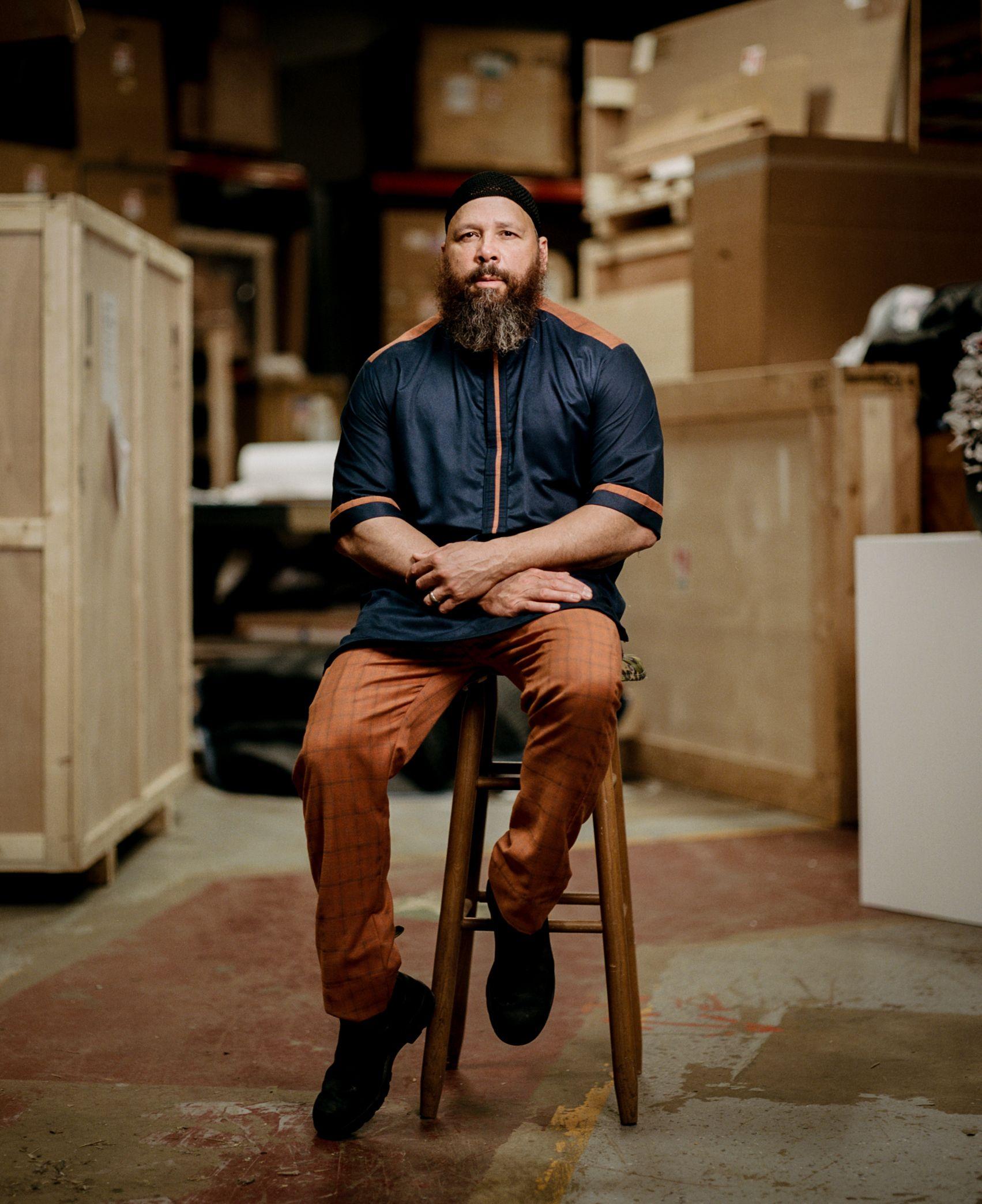
Sharif Bey exemplifies the intelligent transformation of tradition that lies at the heart of the Spector Craft Prize. Drawing on the legacies of modernist abstraction, the art of the African diaspora, and the studio craft movement, his work incorporates many components, each handmade and thereby charged with significance. He assembles these parts into emblematic forms, often large in scale, in which traditional genres—jewelry, vessels, and ritual figures—are powerfully reimagined.
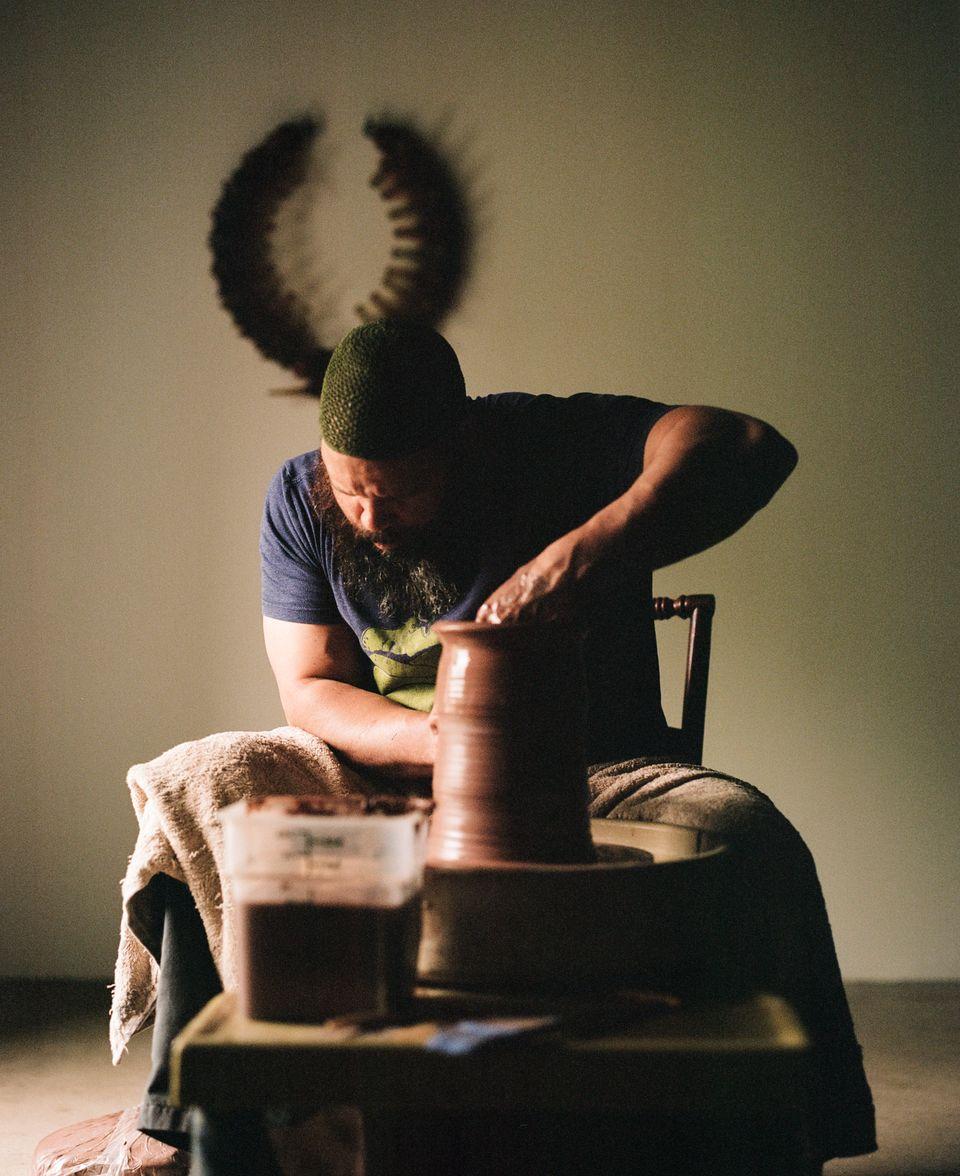
Originally from Pittsburgh, Bey began making pots as a teenager at the Manchester Craftsmen’s Guild, learning alongside visiting and resident artists including Warren MacKenzie, Paul Soldner, and Jun Kaneko. He is currently the subject of an exhibition at the Andy Warhol Museum.
Bey studied sculpture at the Academy of Fine Arts and Design in Bratislava, Slovakia, before earning his BFA from Slippery Rock University, MFA from the University of North Carolina at Greensboro, and PhD in art education from Penn State University. A longtime professor at Syracuse University, Bey has carried forward the mentorship that shaped him as a young artist, becoming an important teacher and inspiration to younger craft artists.
His honors include a United States Artists Fellowship, Pollock-Krasner Foundation Grant, New York Foundation for the Arts Fellowship, and J. William Fulbright Scholarship. His work is held in major public collections including the Smithsonian American Art Museum, Carnegie Museum of Art, Dallas Museum of Art, and Crystal Bridges.
Raptor Return
Earthenware and mixed media
2022
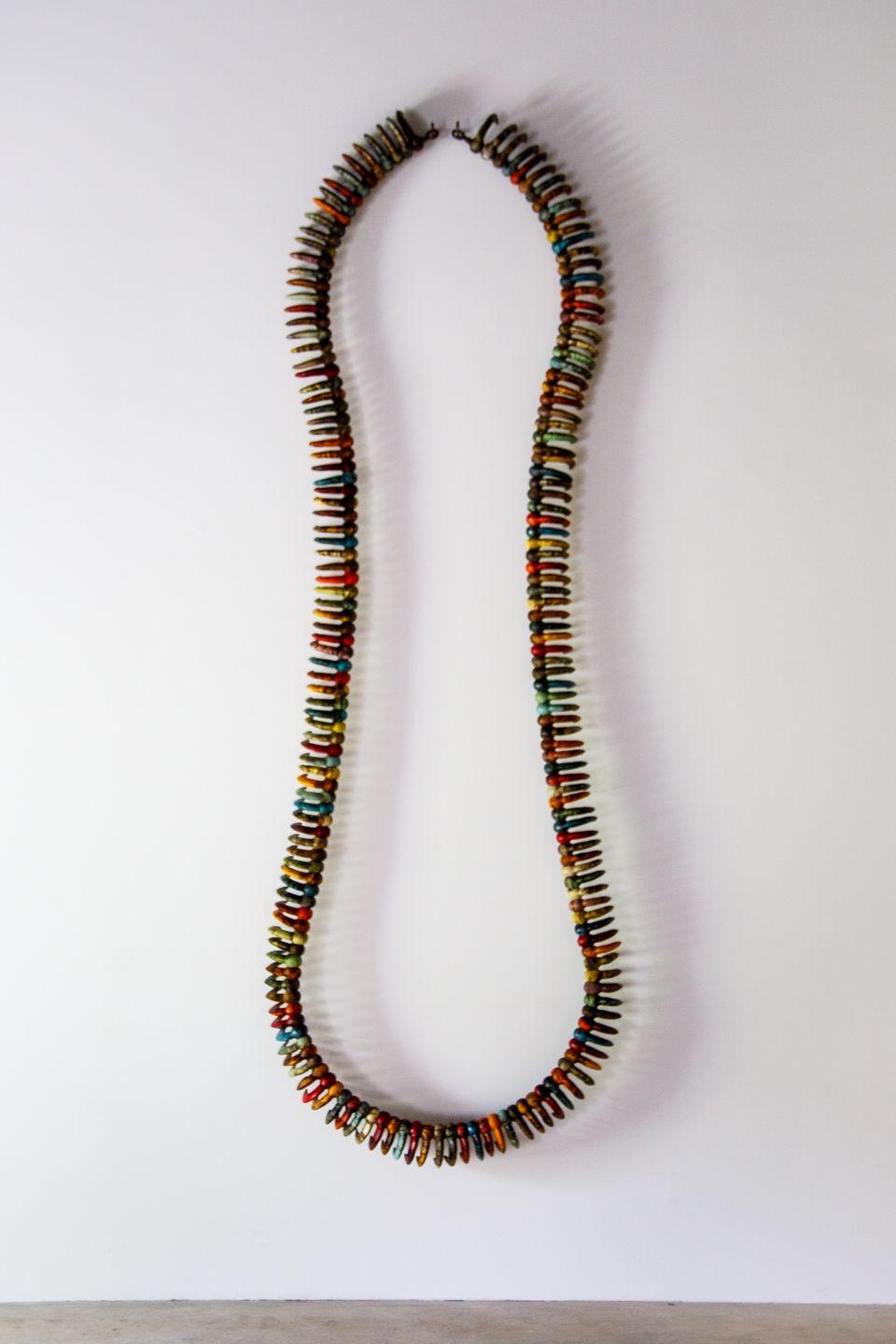
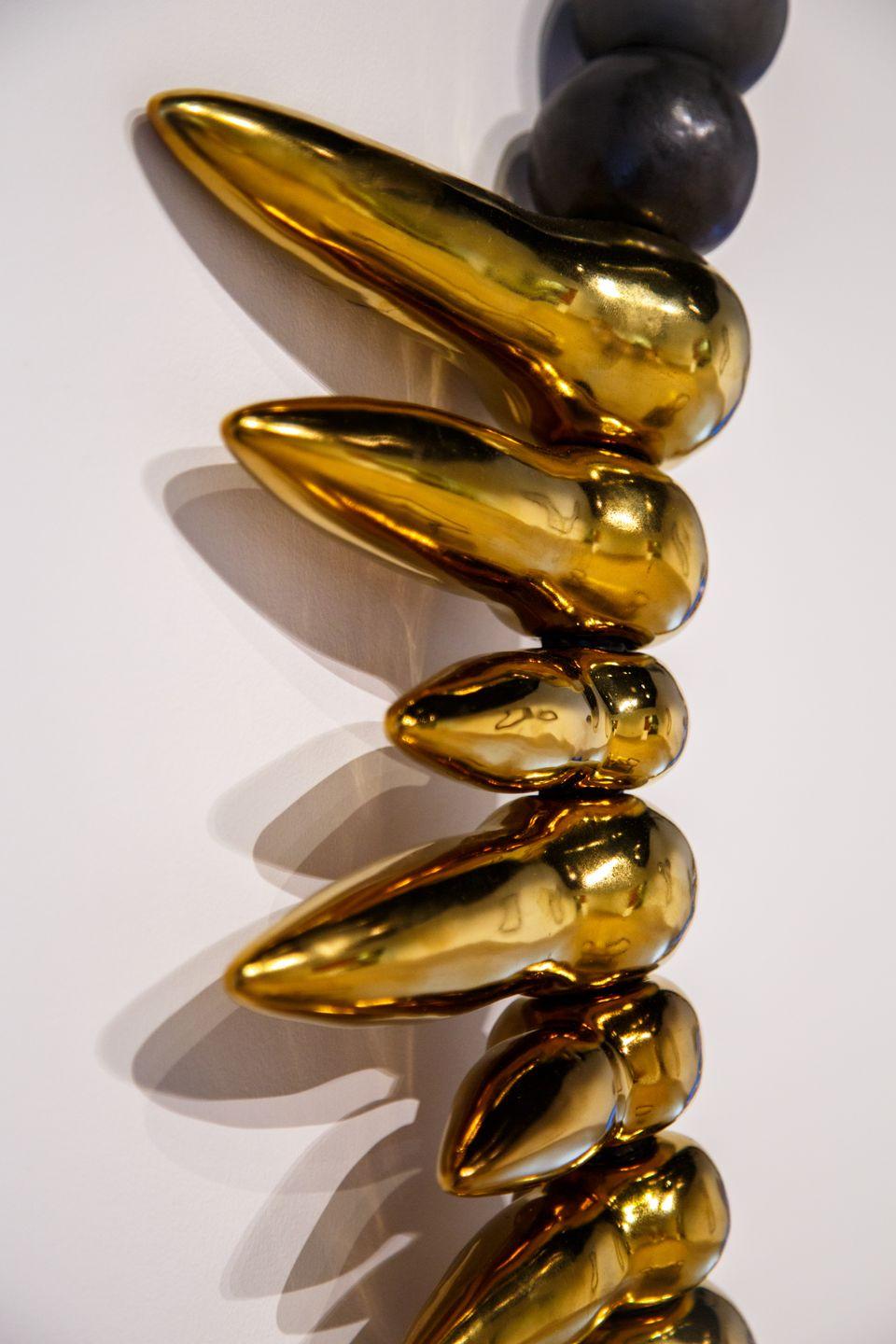
Raptor Return grew from Bey’s exploration of adornment and objects of value, beginning with the large amber necklaces of North Africa. Their scale and weight led him to consider how objects can carry meanings of wealth, regalia, and legacy that transcend their physical comfort. From there, Bey looked beyond conventional forms of value—coins, jewelry, and shells—to the natural world, including bones, claws, talons, beaks, skulls, branches, and coral.
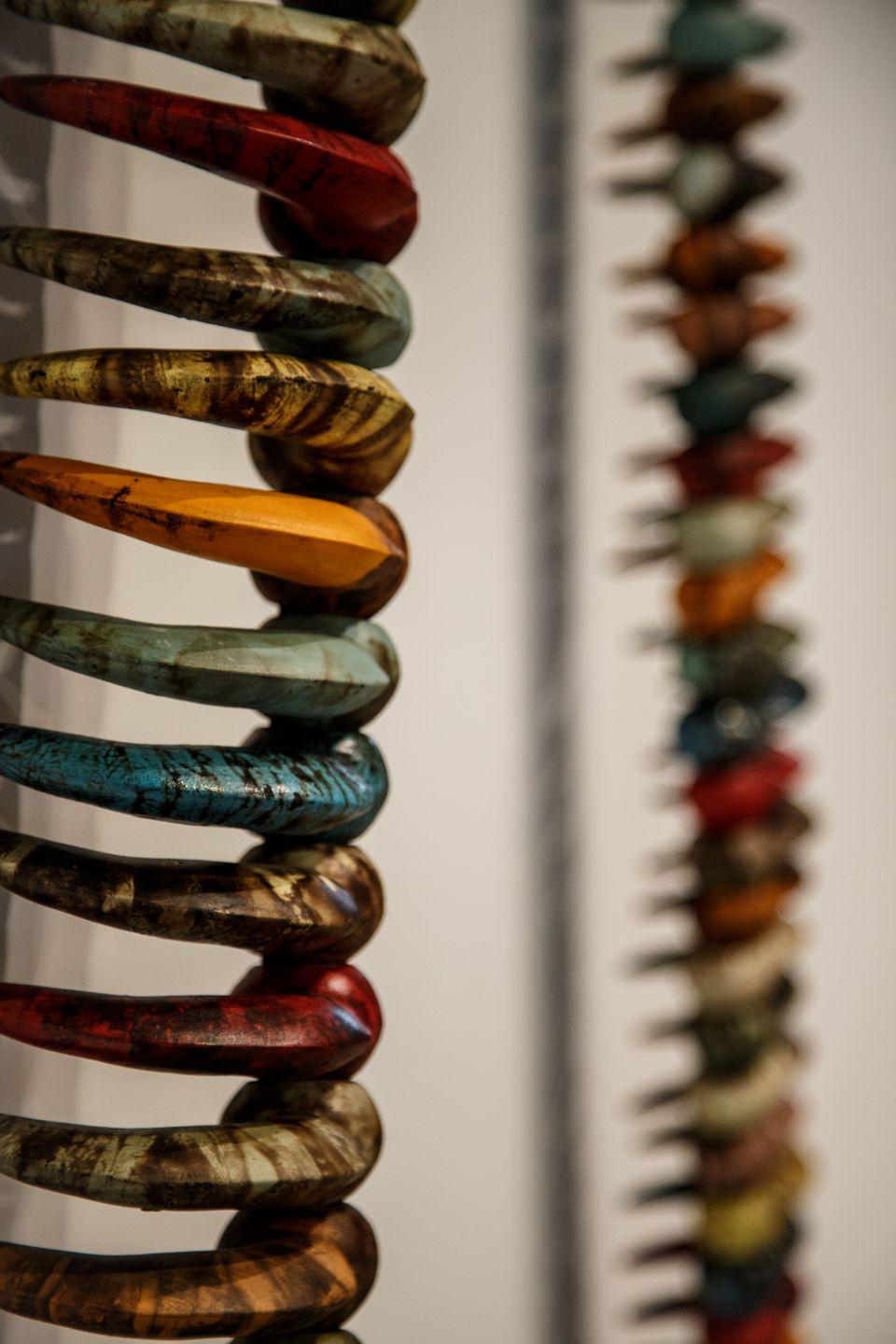
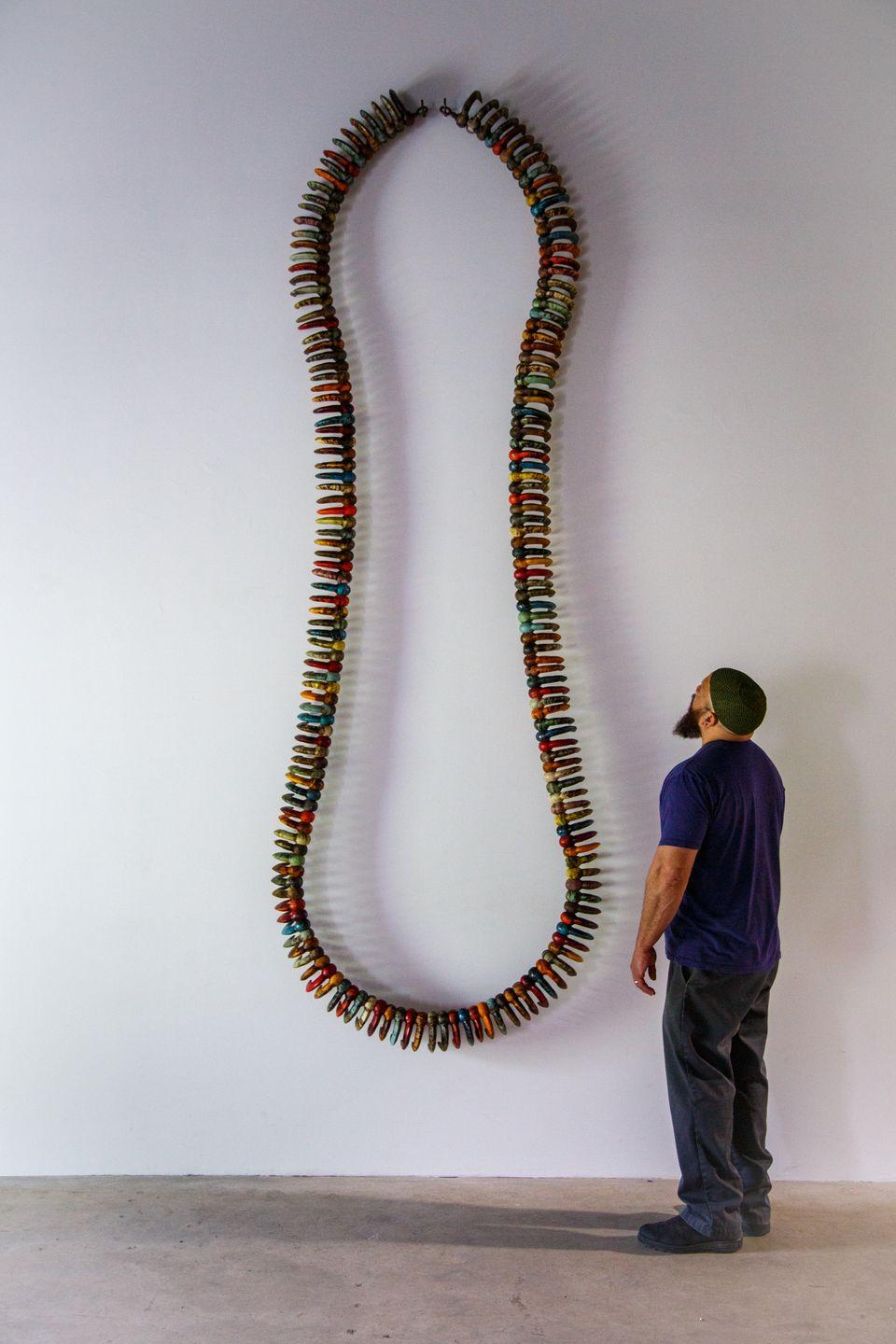
For Bey, the raptor talon became particularly compelling for its distinctive arc and the rhythmic spaces created through repetition. In Raptor Return, repeated ceramic talons create a monumental form that moves between adornment and sculpture. The work extends Bey’s earlier practice of draping adornment on the body, allowing the necklace to transcend the body and occupy space in its own right.
Bey’s Raptor Return enters the permanent collection of Crystal Bridges, with funding from the Spector Family Foundation.
“As both adornment and sculpture, Raptor Return could not be more fitting as an inaugural acquisition in the Spector Craft Prize program—a ceremonial object that seems to bind together the deep past with many possible futures.”
Glenn Adamson, Curator, Author, and Scholar
Interview with Sharif Bey
Your path to ceramics began at the Manchester Craftsmen’s Guild in Pittsburgh as a teenager. Looking back, how did that early experience shape your understanding of craft?
I had an inclusive and thorough introduction to ceramic art through the Manchester Craftsmen’s Guild's renowned visiting and resident artist programs. I often say that I made pots with Warren MacKenzie, fired with Paul Soldner, and handbuilt with Jun Kaneko—and everybody in between, young and old, from various parts of the world. I was also surrounded by examples through the Guild's collection, which included work by Regis Brodie, Dan Rhodes, and Jun Kaneko.
I come from a family of 12, a large working-class family, so learning how to work within a craft tradition also taught me things I wasn't necessarily taught at home: how to manage space, organize things, and work within constraints. Those kinds of life skills, and the awareness I gained through my education as a craftsperson, were integral to my development into adulthood.
Your work moves between functional pottery and large-scale sculpture. How do you think about the relationship between the vessel and the object that transcends utility?
I would describe that relationship as one of convergence and divergence.
I always tell my students that there are things we can learn from pots and from their utility that inform how we think about object-making in general: the psychology of space, ergonomics, the relationship between the body and experience, balance, proximity, and scale. Those things continually inform how I think about sculpture.
There is also a tension around commodification. A pot can require the same amount of energy, conceptual development, and technical investment as a sculpture, but there is still a perceived hierarchy around what craft is. Sometimes it feels as though if I close a form, it becomes sculpture, and if I open it, it becomes craft.
But the conceptual possibilities of empty space, a void, a volume, or a vessel are infinite.
The physical act of making seems central to your work. What does the handmade carry that other modes of making cannot?
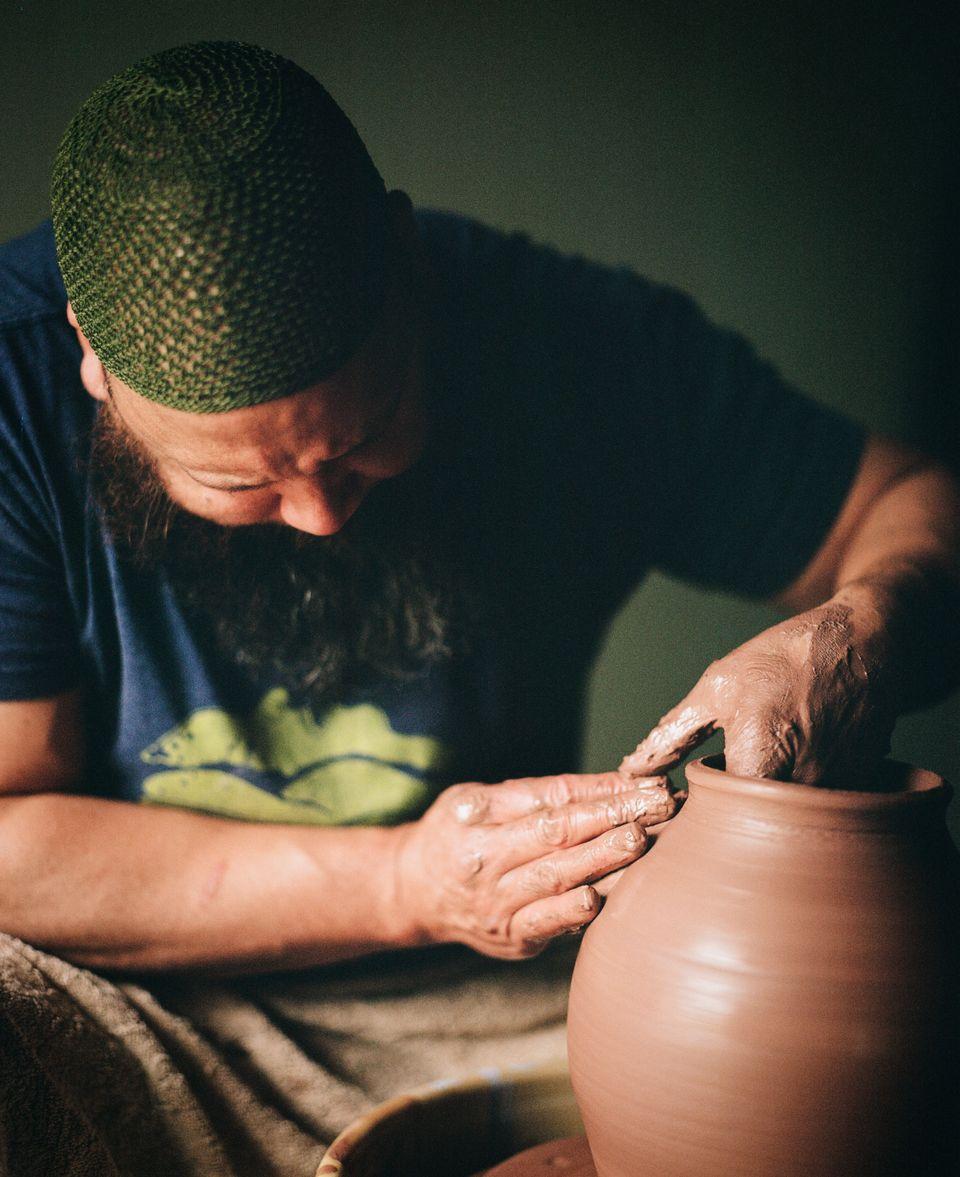
One of the definitions of craft speaks to power, force, or strength. I think that when we work within craft traditions, even if they are not traditions we were born into, we physically carry those traditions into a new time, a new discourse, and a new context.
There is a powerful metaphor in that: my hands from my father's hands, from his father's hands. My particular method and conviction as a maker depend largely on my hands. Often, when I try to employ an assistant, it is very difficult because they don't have my fingers. We have a different touch, a different sensibility, a different pressure.
I recognize the spiritual and meditative aspect of the ritual of making. I like the idea of repeating something until it becomes almost ceremonious. The outcome is the result of the history of the hand in unison with the material, cultivating energy. That is very special to me. There is evidence there—evidence of marks, like a footprint or a fingerprint. That evidence can be traced.
Your work draws on the visual heritage of Africa and Oceania, alongside contemporary craft processes. What are you honoring, and what are you transforming?
I think “transforming” is a good word because it doesn't imply hierarchy. I like to think that I am amalgamating many different kinds of visual references, but also different techniques and processes.
Historically, many non-Western craft traditions—basketry, woodwork, clay, textiles, instrument making—did not always receive credit for the sophistication they contributed to the world. They were often categorized as natural history, as though there were something innate about these traditions rather than generations of knowledge and skill behind them.
Today, our material vocabulary has expanded. We see work made from denim, recycled paper, rubber, nails, and the refuse of industry. I don't feel that my work is held within one specific tradition of making. I am very open to asking: what happens next?
I am a potter. I might throw dozens of teapot spouts on the wheel and integrate them into figures. The way they are made signifies a particular process, but then I recontextualize them. In some ways, I am investing in a dance that potters have long been involved in, and then taking the outcome of that dance and starting a new one.
You are the inaugural recipient of the Spector Craft Prize. What does it mean to be the first artist to receive this award—not just for your own practice, but for what it signals about craft more broadly?
I feel honored for a lot of reasons. When we think about movements for social change, there are people who benefit from the sacrifices, protests, struggles, and pushback against the status quo. Many of the people who made those sacrifices may not have lived to see the benefits of that struggle.
I think the same thing has happened with craft, and with people of color in craft. I feel fortunate because I remember how it was, and I know how it is now. When I was a kid, there were maybe half a dozen people in contemporary craft, in my medium, who were receiving any real level of notoriety. It was a very exclusive group. Awards like this were slim to none.
So the idea that this award exists, and that new awards are still emerging to acknowledge the impact of American craft, is such an honor. To me, it also implies hope. Because this is an inaugural award, its impact can spread. It has the potential to carry the conversation further. When I say I remember the struggle, I mean that I am honored to be able to hold the torch.
As part of the Spector Craft Prize, Raptor Return has been acquired by Crystal Bridges. What does it mean to you for this particular work to enter that collection, and what do you hope viewers encounter when they stand before it?
One of the things that is important about this work is the way it moves between adornment and architectural presence. Is there a relationship between a bracelet, a brooch, or a necklace, and an architectural form, or something that spans ten feet? It is important to me that these works are still experienced in proximity to the body. That is why I appreciate when people take pictures or selfies with my work.
Someone will stand in front of one of my necklaces, and it almost frames them, like a picture frame or a border. They cannot wear it, but they can still find some way to adorn themselves with the piece. I love that idea and that sense of presence.
Crystal Bridges itself has been one of my bucket-list collections since the museum's inception. To be part of this new institution is a great honor. In some ways, this is my most ambitious work to date in terms of scale and presence. I joked to myself that I was going to go hard or go home—but it was going to be Crystal Bridges. This is a major collection, and I feel fortunate to have a major piece in it.